
Working capital requirement measures the amount your business needs to finance to cover the gap between its outgoings (purchases, inventory) and its receipts (customer payments). Working capital optimisation means narrowing this gap to free up cash without systematically turning to external financing.
Working capital is often a far more revealing indicator of a company’s true financial health than net income alone. A profitable business can still run short of cash if its working capital is poorly managed. In this article, we explain what working capital requirement is, how to calculate it, which levers to pull to reduce it, and how to carry out genuine cash flow optimisation across your entire operating cycle.
What is working capital requirement?
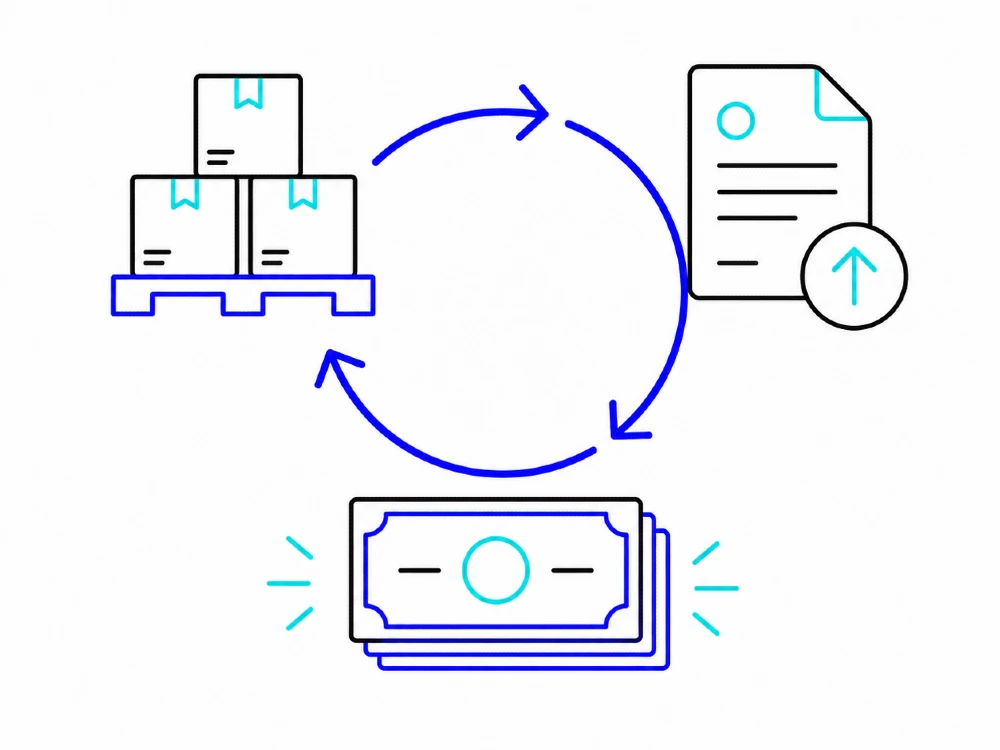
Working capital requirement is the cash needed to finance a company’s operating cycle, between the moment it pays its suppliers and the moment it is paid by its customers. It is calculated as follows:
Working capital requirement = (Inventory + Trade receivables) − Trade payables
A high working capital requirement means the company ties up a large amount of cash in its operating cycle: slow-moving inventory, customers who pay late, suppliers paid too early. Negative working capital, on the other hand, means the company is paid by its customers before it has to pay its suppliers. This is a favourable situation, common in some retail and e-commerce models.
Working capital and working capital requirement: what is the difference?
French accounting distinguishes two concepts that English-speaking finance teams often group under the single term “working capital”. Working capital (fonds de roulement) measures the share of long-term resources (equity, long-term borrowings) that finances fixed assets and, beyond that, the operating cycle. Working capital requirement (besoin en fonds de roulement) measures precisely the need generated by that operating cycle. Put simply: working capital is an available resource, working capital requirement is a need to be covered. A financially healthy company has enough working capital to cover its working capital requirement without constant pressure on its cash.
How do you calculate the impact of working capital on your cash flow?
Calculating the impact of working capital on your cash flow means breaking the operating cycle down into three key timeframes:
- Days inventory outstanding (DIO): on average, how many days does your inventory remain on hand before it is sold or used?
- Days sales outstanding (DSO): how many days pass between issuing an invoice and collecting payment?
- Days payable outstanding (DPO): how many days does your company take to pay its own suppliers?
The simplified formula for the cash conversion cycle is: DIO + DSO − DPO. The higher this figure, the more working capital weighs on your available cash. Every day saved on DIO or DSO, and every extra day negotiated on DPO, automatically frees up cash, with no need to borrow or raise funds.
What are the levers for optimising working capital?
How can you optimise working capital in practice? Three main levers, which can be used independently or in combination, act directly on the operating cycle:
- Optimise the cash tied up in inventory: outsourcing the financing of your procurement through inventory financing eases the pressure on your cash flow while preserving your equity and bank facilities for other projects.
- Reduce days sales outstanding (DSO): professionalising invoicing and debt collection, for example through our Order to Cash solution, speeds up cash collection without damaging customer relationships.
- Reasonably extend days payable outstanding (DPO): negotiate payment terms suited to your cycle, without putting your strategic suppliers in difficulty.
The most effective working capital levers are rarely used in isolation. A company that combines inventory financing with the outsourcing of its customer chain acts on both the upstream and downstream ends of its operating cycle, with a cumulative effect on its available cash.
How do you manage your cash flow day to day?
Reducing working capital as a one-off exercise is not enough: you also need to manage your cash flow continuously. This involves several operational practices:
- A regularly updated cash flow forecast, which anticipates seasonal gaps rather than reacting to them.
- Real-time monitoring of key indicators (DSO, DIO, DPO, inventory levels), rather than monthly reporting after the fact.
- Digitalised invoicing and payment flows, which shorten administrative processing times at every stage of the cycle.
- Regular reviews of the terms negotiated with customers and suppliers, to ensure they remain aligned with market conditions and business activity.
These practices turn cash management from a reactive exercise, triggered by short-term pressure, into proactive management that anticipates financing needs before they become critical.
Working capital management: different challenges by sector
The weight of working capital in a business varies widely depending on its business model:
| Sector | Main source of working capital pressure | Priority lever |
|---|---|---|
| Retail / sales networks | Volume of inventory to finance, seasonality | Inventory financing |
| E-commerce | Peaks in activity, growing number of product references | Inventory financing + automated invoicing |
| Manufacturing | Long production cycle, raw materials | Financing of non-commercial goods |
| B2B | Long customer payment terms | Order to Cash outsourcing |
A manufacturer and an e-commerce business therefore have neither the same working capital profile nor the same priorities for action, which is why a precise diagnosis is needed before choosing one lever over another.
How Atlantiq helps you optimise your working capital for the long term
Atlantiq acts simultaneously on the two main drivers of working capital: inventory and accounts receivable. Our approach combines:
- Inventory financing, to optimise the financing of your procurement and ease the pressure on your cash flow, for both commercial and non-commercial goods.
- Outsourcing your customer chain, to reduce DSO and secure cash collection, with shared real-time monitoring.
- An initial diagnosis of your cash conversion cycle, to identify where the pressure on your working capital really lies before deploying a solution.
The aim is not to offer a standalone financial product, but to act on the entire operating cycle to free up cash for the long term, without weakening your financial ratios or your borrowing capacity for other projects.
Working capital optimisation FAQ
Would you like to identify the most effective levers for optimising your working capital?
Identify ways to optimise your working capital
Talk to our Atlantiq experts


